Furniture labels sound simple until two shops use different names for what appears to be the same chair. That is why the accent chair vs armchair question causes so much confusion. The terms overlap, but they are not identical. An armchair is defined mainly by its construction: it has armrests. An accent chair is defined mainly by its role in a room: it adds visual interest, contrast, or a focal point. So an accent chair can be an armchair, but an armchair does not automatically count as an accent chair.
Understanding that distinction makes shopping easier. Instead of getting stuck on chair terminology, you can focus on how a piece is built, how comfortable it needs to be, and what job you want it to do in your living room, bedroom, office, or reading corner.
The simplest difference between an accent chair and an armchair
The clearest way to separate the two is to ask two questions. For an armchair, ask, “Does this chair have arms?” For an accent chair, ask, “Is this chair being used to add character or emphasis to the room?” One question is about form; the other is about function.
An armchair usually has a back, a seat, and two arm supports. It may be upholstered or made from wood, metal, cane, or another material. It can be plain, decorative, compact, oversized, traditional, or modern. Its defining feature is the presence of armrests.
An accent chair, by contrast, is chosen because it stands out from the rest of the room in some useful way. It may introduce a new colour, pattern, silhouette, texture, or material. Some accent chairs have arms, while others are armless. This is why comparing armchair vs accent chair as if they were completely separate furniture categories can be misleading.
Why the two terms overlap so often
Retailers often use several labels for the same chair because shoppers search by style, function, and construction. A velvet chair with curved arms might be listed as an armchair, accent chair, occasional chair, or lounge chair depending on the shop.
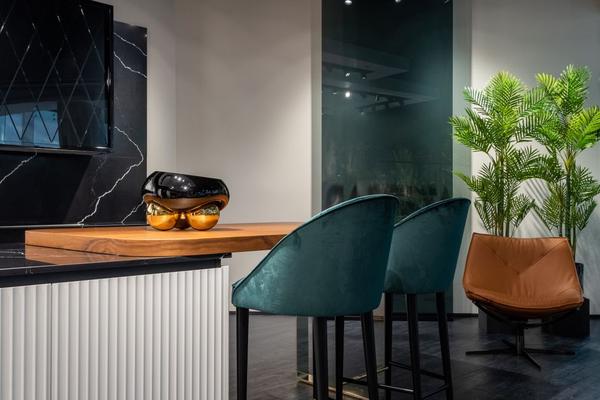
Picture a deep green upholstered chair beside a neutral sofa. Because it has armrests, it is an armchair. Because its colour creates contrast and makes the seating area more visually interesting, it is also functioning as an accent chair. The same chair can legitimately belong to both categories.
How size and comfort usually differ
There is no universal size rule, but armchairs are often selected with everyday comfort in mind. They commonly have supportive arms, a generous seat, and proportions suited to reading, relaxing, or watching television.
Accent chairs can be just as comfortable, but appearance often carries more weight in the buying decision. A sculptural barrel chair, compact slipper chair, or angular wooden chair may be chosen because it balances the room visually, even if it is not the seat you would pick for a long evening.
For small rooms, this matters. A bulky armchair can crowd a narrow layout, while a lighter accent chair can provide an extra seat without blocking sightlines. Measure the full width and depth of the chair rather than relying on the product label.
Armrests are the easiest construction clue
Among common living room seating types, the armrest is the quickest clue. An armchair has arms by definition. An accent chair may or may not have them.
An armless slipper chair in patterned fabric can be an accent chair, but it is not an armchair. A wingback chair with prominent arms can be both. A simple upholstered armchair that matches the sofa exactly may be an armchair without serving much of an accent role.
Which one should you choose?
Choose based on the job the chair needs to perform. If you want a comfortable seat for regular use, prioritise seat depth, back support, arm height, cushion firmness, and enough surrounding space to get in and out comfortably. In that case, an armchair may be the natural starting point.
If the room already has enough practical seating but feels flat or overly matched, an accent chair can introduce contrast. Look for a colour that connects to artwork, a rug, curtains, or smaller accessories rather than choosing something completely unrelated. A distinctive shape can also create contrast without a bold colour.
A practical living room example
Suppose you have a beige three-seat sofa, a light wood coffee table, and a cream rug. You need one extra seat beside a window. A beige armchair would increase seating but might make the room feel visually repetitive. A rust, olive, or deep blue chair could perform both jobs: it can provide supportive arms while also acting as an accent piece.
Before buying, tape the chair’s footprint on the floor with painter’s tape. Leave enough clearance for walking routes and make sure the arms do not clash with a side table or window ledge. This simple test is often more useful than judging scale from a product photo.
How to shop without getting trapped by furniture labels
Chair terminology is useful, but it is not always consistent from one retailer to another. Start with your practical requirements, then use labels as search filters rather than rigid definitions. If you need arms, search armchairs and check accent-chair collections too. If you need a statement piece, browse by colour, upholstery, frame shape, and scale as well as by category.
Useful related topics to explore include choosing an accent chair for a small living room, understanding standard chair dimensions, and matching chairs with a sofa. These are natural next steps because they focus on the decisions that affect comfort and layout.
FAQ
Can an armchair be an accent chair?
Yes. If an armchair is used to add contrast, colour, texture, or a distinctive shape to a room, it can also be considered an accent chair. The two terms describe different aspects of the same piece.
Does an accent chair have to have arms?
No. Accent chairs can be armed or armless. Their defining characteristic is the visual or decorative role they play in the room, not the presence of armrests.
Are accent chairs less comfortable than armchairs?
Not necessarily. Some accent chairs are extremely comfortable, while others prioritise compact proportions or sculptural design. Comfort depends on seat depth, cushioning, back support, and dimensions rather than the label alone.
What is the best choice for a living room?
If the chair will be used every day, choose the most supportive and appropriately sized option first, whether it is marketed as an armchair or accent chair. If extra seating is secondary and the room needs more personality, a visually distinctive accent chair may be a better fit.
The bottom line
The accent chair vs armchair difference becomes clearer once you separate construction from purpose. An armchair is a chair with arms. An accent chair is a chair selected to create visual interest or emphasis. One piece can easily be both.
Rather than worrying about finding the “correct” label, judge the chair by its dimensions, comfort, arm design, materials, and the role it will play in your room. That approach makes the terminology less confusing and leads to a better seating choice for the space you actually have.