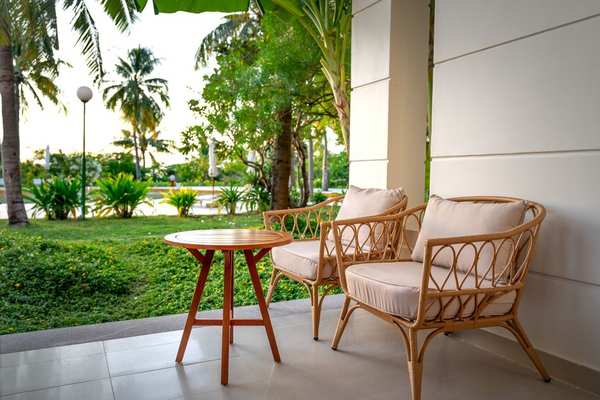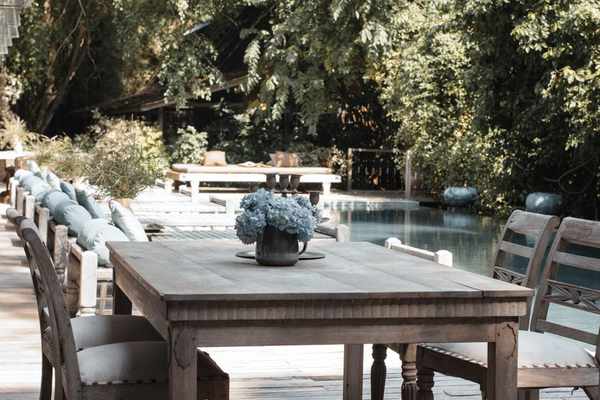
A tiny patio can feel generous with two comfortable seats and a clear path, or crowded with a supposedly compact four-piece set. The difference usually comes down to furniture dimensions, not square footage. Before buying outdoor furniture for small patios, think about how you actually use the space: morning coffee, reading, weeknight dinners, or an occasional extra guest. Choose pieces that support those habits without swallowing the floor.
Measure the Space You Need to Move Through
Sketch the patio’s length and width, the direction the door swings, steps, railings, planters, and outlets. Mark the route from the door to seating. A clear passage of roughly 30 to 36 inches is a useful planning target where space allows, not a universal rule. Applicable building or accessibility requirements may call for something different.
Measure the complete furniture footprint, including chair legs and the room needed to pull out a seat. Use painter’s tape or cardboard to test the arrangement. Sit in a chair within the outline; a table that looks perfect online may be awkward once knees and elbows enter the equation.
Choose Seating for the Way You Relax
A slim loveseat for everyday lounging
If two people normally share the patio, one narrow loveseat can feel calmer than three mismatched chairs. Look for upright arms, exposed legs, and a seat depth that suits your posture. Deep lounge sofas are tempting, but oversized cushions consume precious inches. Check overall width, seat height, and depth before ordering.
Two armless chairs for flexibility
Armless chairs are easy to arrange for conversation, line along a wall, or separate when someone wants to read alone. For small patio seating, this adaptability often beats a fixed sectional. Choose pieces stable enough for your conditions, particularly on windy, exposed terraces.
A compact bench against the edge
A straight-backed bench against a wall can accommodate two people without projecting as far as some lounge chairs. A corner bench works only if it leaves a comfortable exit route. Never block door clearances, drainage, ventilation, or access to equipment. A removable cushion adds comfort without permanently increasing the bulk.
Let Tables Earn Their Footprint
A traditional coffee table is often the first thing to remove. A slim side table holds drinks and books while keeping the center open. Nesting tables provide an extra surface for visitors and tuck away afterward. Confirm the smaller table truly fits beneath the larger one.
For meals, consider a round bistro table or a folding table beside a wall. Rounded corners are easier to pass, although the base matters as much as the top. A pedestal can improve legroom; a wide tripod may do the opposite. Measure the furthest point of the legs, not just the tabletop.
Use Folding and Stackable Pieces Strategically
Folding chairs are ideal for occasional guests, provided they’re sturdy enough for comfortable use. Decide where they’ll go when closed. Stackable stools can provide overflow seating, but check the manufacturer’s stacking limits. Two permanent seats plus one stored extra often beat four chairs that crowd every day.
Good space saving patio furniture changes with the occasion rather than forcing the patio to look party-ready all week. Keep folding hinges clean, secure unused chairs in windy conditions, and follow the maker’s storage directions.
Try a Real Layout Before Buying
Imagine a patio measuring 6 by 8 feet, with a door opening onto one short side. A large dining set would dominate it. Instead, test two narrow chairs along the long wall, a shared side table, and a stool that tucks underneath when not needed. Tape out the dimensions and confirm the door opens completely.
If you eat outside more than you lounge, a bench at the far end and a folding bistro table might work better. Neither arrangement is guaranteed to fit. The actual chair dimensions, door swing, and space needed to move around them determine the answer.
Choose Materials That Suit the Weather
Compact outdoor furniture must survive its setting, not merely look attractive in photographs. Powder-coated aluminum is generally light to move and corrosion-resistant when its finish remains intact. Suitable outdoor woods bring warmth but require care appropriate to the species and finish. Synthetic wicker varies in quality, ultraviolet resistance, and frame construction.
Check product guidance for sun, heavy rain, salt air, and freezing conditions. Outdoor-rated cushions are helpful, but water-resistant fabric does not make every cushion waterproof. Let cushions dry thoroughly and store them during extended wet weather. For many outdoor upholstery fabrics, mild soap, water, thorough rinsing, and air drying are suitable; always follow the specific care label.
Keep Storage Away From the Walking Route
A storage bench sounds efficient until its lid needs space to lift. Check both closed dimensions and opening clearance. A narrow outdoor-rated box may hold accessories, but verify its weather-resistance claims and never pack damp fabric inside. For further inspiration, look into outdoor cushion storage ideas without adding a large cabinet that leaves nowhere to sit.
Create an Open Feeling Without Losing Comfort
Visible furniture legs often appear lighter than solid bases. Repeating a frame finish across chairs and tables also reduces visual clutter, even if the pieces are not a matching set. Comfort still matters more than a minimalist photograph: a beautiful chair nobody enjoys sitting in is wasted space.
Use wall-mounted planters or a slim privacy screen to keep floor space available, but check secure fixings, wind exposure, and building restrictions. If overlooking neighbors are the issue, balcony privacy ideas may be more useful than another chair. Explore small patio layout ideas before buying large pieces that dictate the entire arrangement.
Frequently Asked Questions
What furniture works best on a very small patio?
Start with two slim chairs or a narrow bench and one small side table. That covers everyday seating without dedicating the floor to a bulky set. Add a folding chair only if there’s a sensible storage spot.
Is a sectional suitable for a small patio?
Sometimes, especially in a square corner with a clear entrance. On a long, narrow patio, a sectional may block circulation and limit rearrangement. Map its full footprint, including cushion overhang, first.
Can balcony patio furniture work on a ground-level patio?
Yes. Balcony patio furniture often features compact tables, folding frames, and narrow chairs that also work at ground level. Evaluate stability, drainage, exposure, and the surface beneath the legs rather than relying on product labels.
How much room should I leave around patio chairs?
Leave enough space to sit, stand, and walk past comfortably. A 30- to 36-inch clear route is a useful initial target where feasible, but dining chairs require additional pull-back room. Test your exact arrangement.
Make Everyday Use the Priority
A successful little patio doesn’t need to seat a crowd all the time. It needs to make your ordinary outdoor routine easy. Start with comfortable seating, preserve a clear route, and add flexible pieces only when they have a job. Furniture chosen for how you live can make even a modest patio feel like an extra room.